






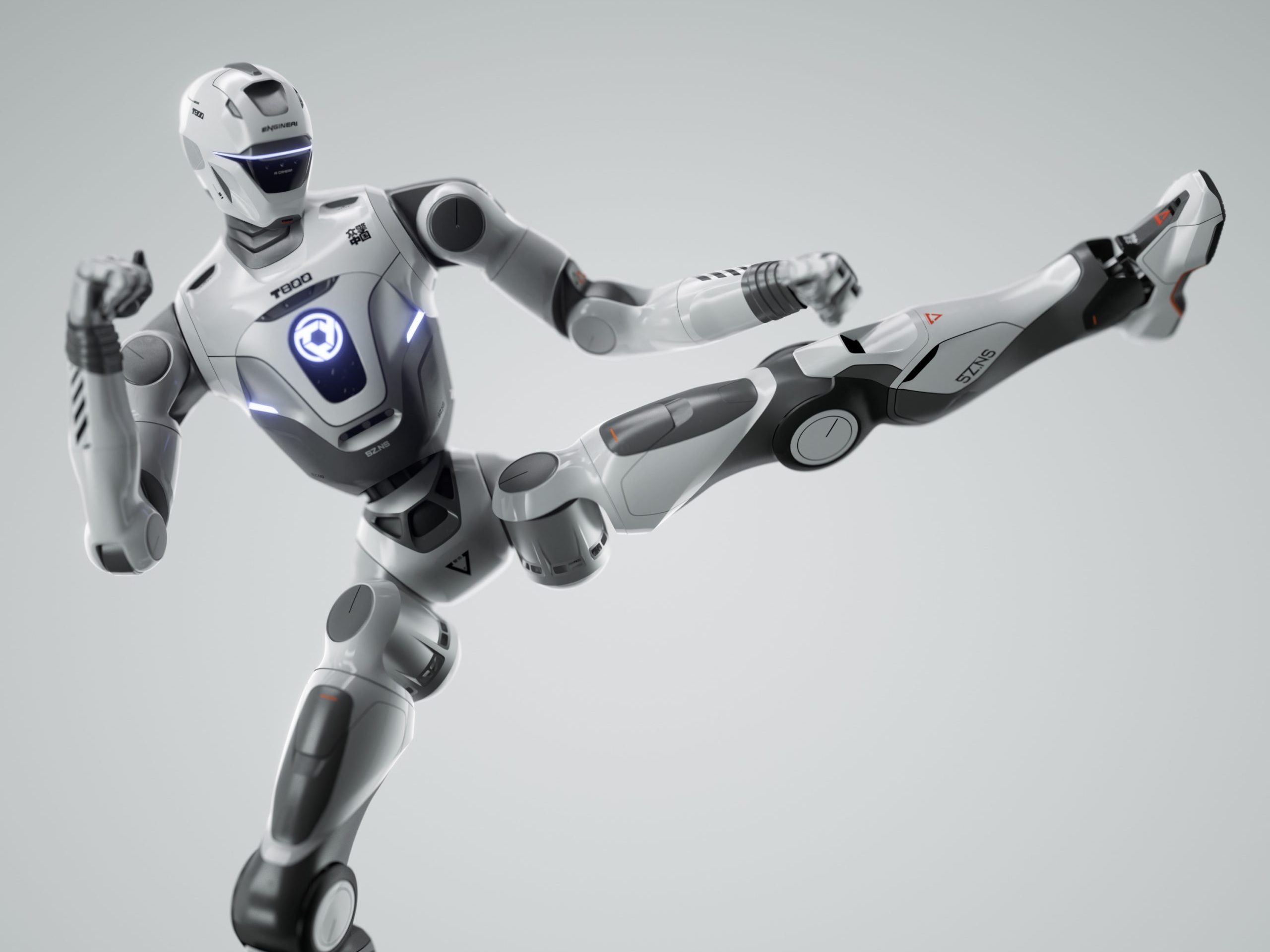
“All Real Footage, No CGI, No Speed Up”: Combat robot’s martial arts demonstration captivates humanoid community, reveals game changing specifications and affordable pricing tiers
When EngineAI teased its “combat-ready” T800 humanoid robot earlier this year, speculation ran wild about its capabilities and potential dominance in robot boxing competitions. Now, following the official December 2nd unveiling complete with a cinematic demonstration video, the robotics community’s response is unanimous: the T800 has exceeded even the most optimistic expectations.
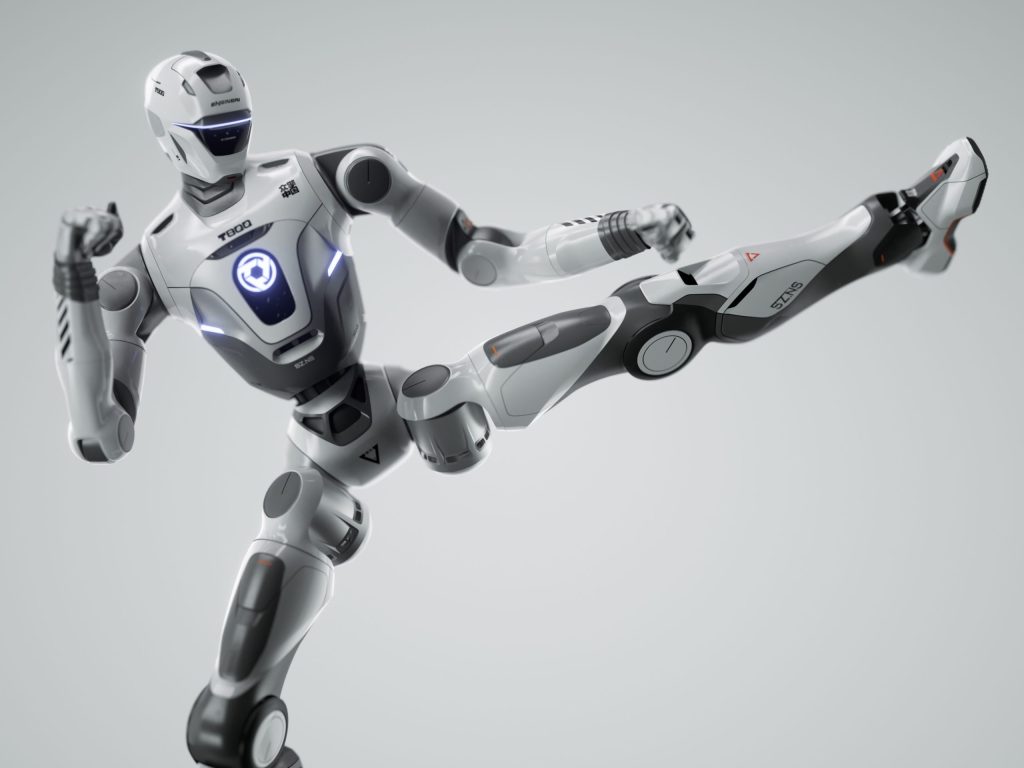
The official reveal video, featuring the T800 kicking open swinging doors, executing jump kicks, performing spinning strikes, and demonstrating fight combinations that evoke Bruce Lee, has gone viral across social media platforms. Internet commentators immediately declared that the American film “Real Steel” pales in comparison to how advanced Chinese humanoid combat robots have become.
Official Specifications: More Powerful Than Initially Reported
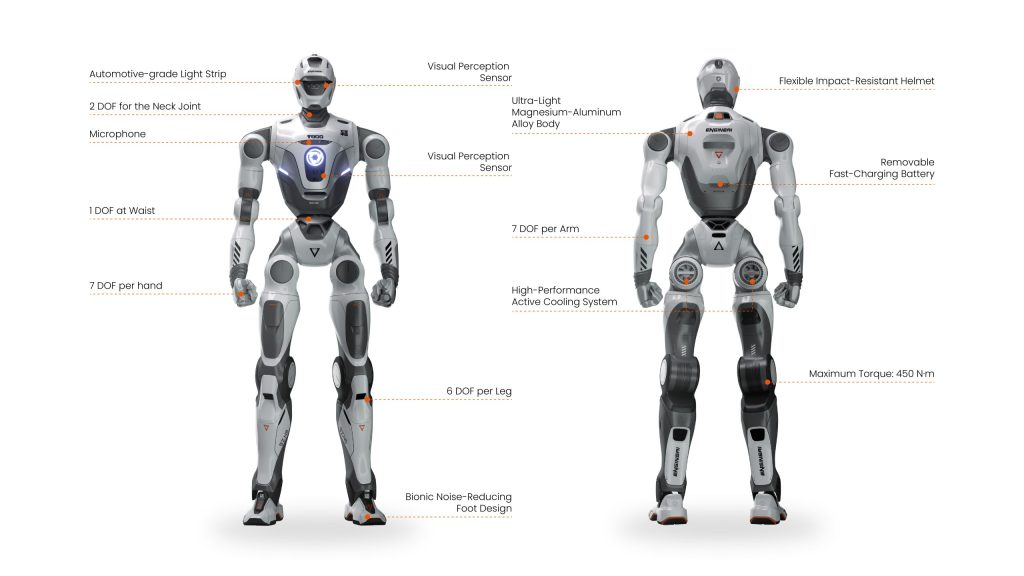
EngineAI’s official technical specifications reveal that the production T800 differs from earlier leaked information, with several upgrades that position it as one of the most physically capable humanoid robots currently available:
Updated Physical Specifications
- Height: 173 cm (5’8″) – (shorter than initial 185 cm reports)
- Weight: Approximately 85 kg (187 lbs)
- Degrees of Freedom: 29 DOF excluding hands (not the 41 initially reported)
- Maximum Joint Torque: 450 N·m per joint
- Peak Power Output: 14,000W instantaneous joint power
- Maximum Speed: 3 m/s (approximately 6.7 mph / 10.8 km/h)
Technical Capabilities
- Perception System: 360 degree omnidirectional environmental monitoring with no blind spots
- Vision Systems: Intel RealSense D415/D435i depth cameras plus AC1 sensor suite
- Compute Platform: Nvidia Jetson Thor chip capable of 2,000 TOPS (FP4) in Pro and Max versions
- Battery: 72V quick release battery system
- Runtime: 2-4 hours depending on activity intensity (upgradeable to 4-5 hours)
- Active Cooling: Integrated into leg joints for sustained high performance operation
The 450 N·m maximum joint torque represents a significant achievement. This torque output explains the robot’s explosive jumping capability and dynamic movement patterns showcased in the demonstration footage.
Pricing Strategy: Four Tier Model Starting at $25,000
Perhaps the most surprising revelation from the official launch is EngineAI’s aggressive pricing strategy. The company announced a four tier product lineup designed to address diverse market segments:
Base Model: Starting from 180,000 yuan (approximately $25,000 USD)
Ecosystem Edition: Open source version for developers and researchers
Pro Version: Enhanced capabilities with Nvidia Thor compute
Max Version: Flagship configuration with maximum performance specifications
This pricing represents a dramatic undercut of premium humanoid robots like Figure 02 (estimated $150,000+) and positions the T800 competitively against other Chinese manufacturers. As detailed in comprehensive humanoid robot pricing analyses, the sub-$30,000 price point makes combat-capable humanoids accessible to universities, sports organizations, and serious enthusiasts for the first time.
The tiered approach mirrors EngineAI’s strategy with its previous PM01 robot, which initially priced at approximately $14,000 to undercut Unitree’s G1. This aggressive pricing philosophy appears designed to capture market share rapidly while maintaining enough margin to fund continued R&D through revenue rather than relying solely on venture capital.
“No CGI, No AI, No Speed Up”: Addressing Skepticism Head On
EngineAI made an unusual and emphatic claim with its reveal video: every movement shown represents actual robot performance with zero digital manipulation, artificial intelligence enhancement, or video speed adjustment. The company’s official statement reads: “All real footage, no CGI, no AI, no video speed up.”
This transparency directly addresses skepticism that has plagued previous humanoid robot demonstrations, where companies occasionally showed simulated or digitally enhanced capabilities that production units couldn’t replicate. The robotics community has historically viewed such practices as counterproductive, eroding trust when reality fails to match promotional materials.
To further bolster credibility, EngineAI released raw, unedited footage shot on mobile phones with no cuts, inviting skeptics to pause and examine any frame. Community responses on X (formerly Twitter) and robotics forums have been overwhelmingly positive, with technical analysts confirming the footage appears genuine based on movement physics, shadow consistency, and dynamic stability patterns.
Community Reactions: “The Bar Just Got Raised”
Prominent voices in the humanoid robotics community have expressed amazement at the T800’s capabilities:
On Dynamic Movement Quality:
Robotics analysts on Humanoids Daily noted that the round kicks, jumping, and spinning movements “suggest a level of dynamic stability rarely seen in full sized humanoids.” The footage demonstrates capabilities that most industry observers didn’t expect to see in production robots for another 12-18 months.
On Combat Applications:
Combat robotics enthusiasts on social media platforms immediately began speculating about the T800’s dominance in upcoming tournaments. One widely shared comment stated: “American Real Steel is nothing compared to how advanced Chinese robots have become.” The reference to the 2011 film starring Hugh Jackman, which depicted robot boxing as futuristic entertainment, underscores how rapidly science fiction is becoming reality.
On Industrial Implications:
While the combat demonstrations captured headlines, industry analysts at Humanoid.guide emphasized the robot’s practical applications: “The T800 shows EngineAI’s progress toward a mature humanoid platform suitable for heavy duty environments. It blends mobility, strength, and a scalable architecture that supports future updates.”
On Market Positioning:
Mike Kalil, a prominent robotics industry commentator, characterized the T800 as “the physical embodiment of this moment: a machine built to impress crowds and perform in the ring today, with the hardware headroom to eventually work in the warehouse tomorrow.”
The “Action Hero” Aesthetic: Marketing Genius or Gimmick?
EngineAI’s marketing strategy for the T800 leans heavily into cinematic spectacle, the Terminator naming convention, the Iron Throne display at WRC 2025, the martial arts demonstration video, and the explicit “combat-ready” positioning. This approach sharply contrasts with competitors who emphasize logistics efficiency, manufacturing applications, and commercial utility.
Critics within the robotics establishment initially dismissed this strategy as gimmicky. However, the viral success of EngineAI’s previous demonstrations, including the PM01’s front flip stunt and “Kung Fu Hustle” homage video, plus its dance collaboration with popular streamer IShowSpeed, suggests the company understands modern marketing dynamics better than traditional robotics firms.
As Humanoids Daily observed, “This dual track approach, using high visibility entertainment to fund and stress test hardware intended for mundane labor, is becoming EngineAI’s signature.” The company recently deployed robots as “Cyber Staff” in a Shenzhen retail store in partnership with JD.com, proving they’re willing to put hardware into real world commercial applications, not just viral videos.
The strategy appears to be: generate revenue and attention through spectacular demonstrations and combat competitions, then leverage that visibility to sell robots for industrial, commercial, and research applications. It’s a playbook that consumer technology companies have used successfully for decades but remains novel in industrial robotics.
Technical Deep Dive: What Makes the T800 Combat Capable
Several engineering decisions distinguish the T800 from general purpose humanoids:
Power and Torque Density
The 450 N·m maximum joint torque combined with 14,000W instantaneous peak power output provides explosive movement capability essential for combat scenarios. For comparison, even advanced humanoid athletes like Unitree’s G1 and R1 demonstrating athletic prowess typically operate with lower peak power outputs optimized for efficiency rather than explosive force.
Active Thermal Management
The integration of active cooling in leg joints allows sustained high intensity operation without thermal throttling, critical for multi round combat competitions where overheating could compromise performance. This engineering choice prioritizes peak performance duration over weight reduction.
360 Degree Perception
Unlike robots that rely primarily on forward facing cameras, the T800’s omnidirectional perception system eliminates blind spots, essential in combat scenarios where opponents can attack from any angle. The multi sensor fusion system integrates vision, tactile, and force sensors for real time environmental awareness.
Structural Resilience
Aluminum alloy covers provide protection for internal components while maintaining reasonable weight. In robot combat sports, where impacts and falls are inevitable, structural integrity directly correlates with competitive longevity. The T800’s cruiserweight to heavyweight boxing division equivalent build (187 lbs) provides inherent advantages in collision scenarios.
Compute Architecture
The Nvidia Jetson Thor chip delivering 2,000 TOPS of computing power enables real time decision making in dynamic, unpredictable environments. This processing capacity allows the robot to analyze opponent movements, predict trajectories, and execute defensive or offensive responses within milliseconds—capabilities that distinguish autonomous combat from pre-programmed demonstrations.
Implications for Humanoid Sports
EngineAI has scheduled the T800 to compete in the “Robot Boxer” free combat competition on December 24th, 2025, as part of the larger “Mecha King” tournament in Shenzhen. This event represents a watershed moment for robot combat sports.
Success would validate several propositions:
- Commercial Viability: Demonstrating that robot combat can attract audiences, generate sponsorship revenue, and function as sustainable entertainment
- Technical Readiness: Proving that current humanoid technology supports genuine athletic competition rather than just choreographed demonstrations
- Safety Protocols: Establishing that robot combat competitions can operate safely without endangering spectators, operators, or property
- Rule Standardization: The pioneering rules for this competition, requiring robots to simulate human movement patterns and make real time intelligent decisions, could become standards for future events
Failure would expose current technological limitations and suggest the industry needs more development time before autonomous combat becomes compelling entertainment.
As noted in recent market analyses, the humanoid robot sports industry could realistically grow into a $50-200 billion market by 2040-2050, but only if early competitions like the Mecha King tournament demonstrate genuine entertainment value and technical competence.
How the T800 Compares to Competition
The T800 enters a increasingly crowded field of combat capable humanoids:
Versus Unitree Robots
Unitree’s robots have demonstrated impressive athletic capabilities, particularly in basketball demonstrations and stage performances. However, these robots prioritize agility and efficiency over raw power, different design philosophies optimized for different applications.
Versus AgiBots A2
AgiBots’ A2 humanoid recently set a world record walking 66 miles across China in three days, demonstrating extraordinary endurance and reliability. The A2 excels at sustained operation, while the T800 optimizes for explosive power and dynamic movement, again, different strengths for different use cases.
Versus Western Competitors
When comparing humanoids to human athletes in 2025, Chinese manufacturers like EngineAI have generally prioritized rapid iteration, aggressive pricing, and practical deployment over the methodical, research focused approach favored by Western companies like Boston Dynamics and Figure. The T800 exemplifies this philosophy, ready for combat competition now, with industrial applications to follow, rather than waiting for perfection before deployment.
The Ecosystem Play: Open Source Version Signals Broader Strategy
The inclusion of an “Ecosystem Edition” with open source components in EngineAI’s product lineup reveals strategic thinking beyond hardware sales. By enabling developers, researchers, and enthusiasts to modify, experiment with, and build upon the T800 platform, EngineAI positions itself to benefit from community driven innovation.
This approach mirrors successful strategies in consumer technology (Android) and industrial robotics (ROS ecosystem). An active developer community accelerates capability advancement, identifies novel use cases, creates complementary products and services, generates buzz and visibility, and ultimately drives platform adoption.
For humanoid sports specifically, an open ecosystem could enable:
- Custom fight strategies and AI behaviors developed by competitive teams
- Specialized control systems optimized for different combat styles
- Third party sensors and actuators expanding capabilities
- Competition simulation software for training and strategy development
- Integration with betting platforms and spectator experiences
Retail Deployment: The “Cyber Staff” Reality Check
Despite the T800’s combat focus, EngineAI maintains perspective on near term commercial viability. The company’s recent deployment of humanoid robots as “Cyber Staff” in a Shenzhen retail store (partnering with e-commerce giant JD.com) demonstrates pragmatic business strategy.
The official T800 product documentation explicitly notes that “humanoid robot technology is still in the early stages of development,” warning users to understand the “functional boundaries and application limits” before purchasing. This cautionary language, unusual for promotional materials, reflects what Goldman Sachs characterized as a broader industry pivot toward “dedicated purpose” roles where futuristic appearance provides value while “general purpose” intelligence continues developing.
Similar dynamics are visible in other markets, such as the UK’s Humanoid launch of the Middle East’s first dedicated humanoid robotics showroom in Riyadh, these specialized deployment scenarios allow companies to generate revenue and gather operational data while technology matures toward true general purpose capability.
The Combat Sports Catalyst: Why Fighting Accelerates Development
EngineAI and other industry players view combat competitions as valuable R&D accelerators, not merely spectacle. High stress fighting scenarios test robots in ways that factory floors and retail environments cannot:
Dynamic Balance Under Impact: Combat requires maintaining stability while absorbing strikes, executing attacks, and responding to opponent movements, far more demanding than walking on flat surfaces or manipulating objects.
Real Time Decision Making: Fighters must analyze opponent behavior, predict actions, identify opportunities, execute strategies, and adapt when plans fail, all within milliseconds without human intervention.
Mechanical Stress Testing: Combat exposes structural weaknesses, joint limitations, and failure modes that might not emerge during normal operation, providing crucial engineering feedback.
Public Engagement: Combat creates emotional investment and narrative drama that logistics demonstrations cannot match, driving public interest and investment that accelerates the entire industry.
As concepts like Humanoid Royale explore how battle royale formats could become the biggest robot sport, the T800’s combat capabilities position EngineAI at the forefront of this emerging entertainment category.
Manufacturing Scale: The Path to Accessibility
EngineAI’s announcement of full scale production capabilities marks a significant milestone. The company’s “end to end digital smart manufacturing base” reportedly integrates professional grade automated production lines, premium supply chain partners, and refined quality control systems.
This infrastructure development mirrors the path taken by Chinese EV manufacturers, who achieved global dominance through massive manufacturing scale that dramatically reduced costs while maintaining quality. If EngineAI successfully replicates this playbook with humanoid robots, the $25,000 base price for the T800 could drop further, potentially reaching the sub-$15,000 range within 2-3 years.
Such price points would democratize access to competition grade humanoid robots, enabling universities, sports clubs, and even individual enthusiasts to field competitors in robot combat leagues. As explored in comprehensive analyses of the humanoid sports market potential, accessibility directly correlates with market growth, more competitors means more leagues, more spectators, more sponsorships, and ultimately a sustainable sports entertainment ecosystem.
What’s Next: The December 24th Showdown Approaches
As the Mecha King tournament scheduled for December 24th, 2025 approaches, anticipation builds throughout the robotics and sports entertainment communities. The T800’s official unveiling video has set expectations extraordinarily high, perhaps too high.
The key questions facing EngineAI and the broader humanoid combat sports industry:
Can Real Competition Match Promotional Videos?
Demonstration videos in controlled environments often showcase capabilities that prove difficult to replicate in competitive scenarios with opponents actively disrupting plans.
Will Autonomous Combat Be Compelling?
Early robot combat leagues like BattleBots succeeded because human operators made real time decisions. Autonomous humanoid combat requires robots to “think” for themselves will this prove entertaining or frustrating?
Can Infrastructure Support Competition?
Rules, officiating, safety protocols, scoring systems, and spectator experiences all need development. The December 24th tournament will test whether the ecosystem surrounding combat is ready, not just the robots themselves.
Will Media and Sponsors Care?
Ultimately, robot combat sports needs broadcasting deals, sponsorship revenue, and mainstream media attention to become sustainable. The Mecha King tournament represents the first major test of commercial viability.
Success would position EngineAI as the dominant player in an emerging multi billion dollar industry. Failure would provide valuable lessons but potentially slow industry momentum as investors and audiences recalibrate expectations.
The Stakes Have Never Been Higher
EngineAI’s official T800 unveiling represents more than one company’s product launch, it symbolizes humanoid robotics reaching a critical inflection point where science fiction aesthetics meet genuine capability, where promotional spectacle confronts practical reality, and where entrepreneurial ambition tests market receptivity.
The viral demonstration video’s authentic, unmanipulated footage of a humanoid robot executing martial arts combinations represents technological achievement that most experts didn’t expect to see in 2025. The aggressive $25,000 base pricing challenges assumptions about accessibility barriers. The December 24th combat competition will test whether the technology, infrastructure, and audience appetite align to create a viable new sport.
For those tracking the humanoid robotics industry comprehensively, the T800 stands as a landmark development—not necessarily because it’s the most technically advanced humanoid ever created, but because it represents the most successful fusion of capability, pricing, marketing, and strategic positioning in service of a specific vision: making robot combat sports real.
Whether that vision succeeds or fails, the T800 has already accomplished something remarkable, it made the world believe that robot boxing could be spectacular, accessible, and imminent. That shift in perception may prove more valuable than any individual tournament result.
Want to stay ahead of every breakthrough in humanoid robot sports? Subscribe to the Humanoid Sports Newsletter for exclusive coverage of upcoming tournaments and events, in-depth analysis of emerging technologies, competition results, and insider insights as humanoid sports evolves from novelty to mainstream entertainment. Be part of the revolution from day one.