




The Robot Fighting Arms Race: Who’s Leading the Charge
Humanoid robot combat has rapidly evolved from experimental demonstrations to a burgeoning entertainment industry with multiple companies competing to dominate this emerging market. Unlike traditional robot combat shows like BattleBots that feature wheeled or tracked machines, these new ventures focus specifically on bipedal humanoid robots controlled by human operators or AI, creating a spectacle that more closely resembles human combat sports.
The industry landscape divides into three primary categories: hardware manufacturers developing combat capable robots, entertainment companies organizing fighting leagues and events, and supporting businesses creating betting platforms and infrastructure. Together, these companies are racing to establish humanoid combat sports as the next major entertainment category, with China’s humanoid robot market projected to reach 870 billion yuan ($120 billion) by 2030 according to the Chinese Institute of Electronics.
Hardware Manufacturers: Building the Fighters
Unitree Robotics: The Industry Standard
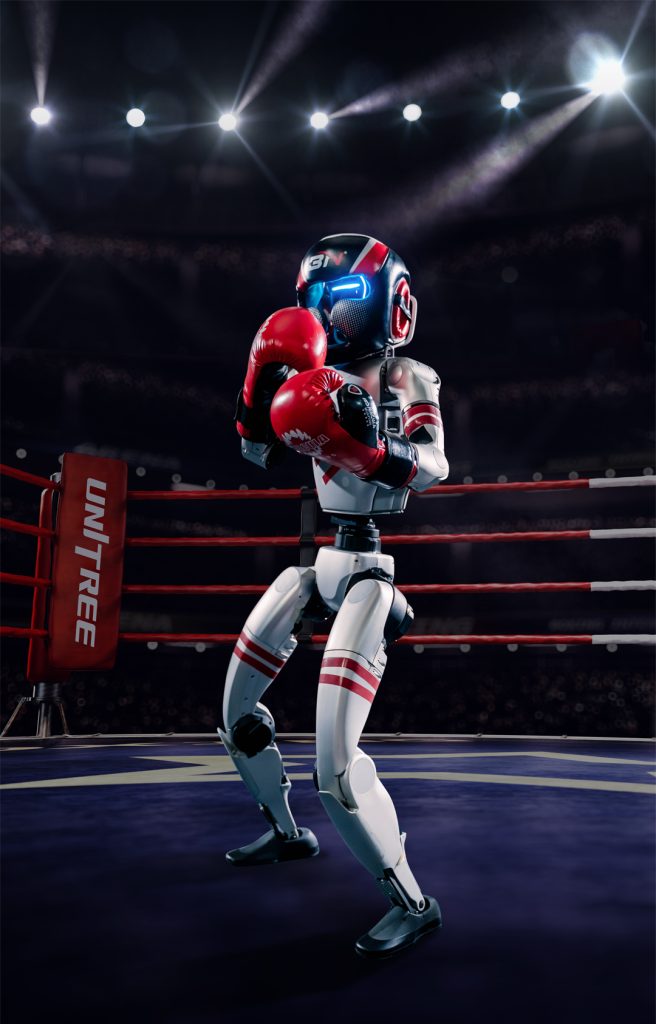
Hangzhou based Unitree Robotics has emerged as the dominant hardware platform for humanoid combat sports. The company’s G1 model, standing 127cm (4’2″) tall and weighing approximately 35kg, has become ubiquitous in robot fighting events due to its accessibility and capabilities.
Priced at $16,000, the G1 represents a breakthrough in affordability for capable humanoid platforms. The robot features advanced motion capabilities including straight punches, hook punches, sidekicks, aerial spin kicks, and autonomous fall recovery. Unitree has specifically trained G1 models for combat through motion capture based training and reinforcement learning, enabling fluid fighting movements.
In May 2025, Unitree partnered with China Media Group to host the world’s first humanoid robot boxing competition in Hangzhou, featuring four operator teams controlling G1 robots in tournament style matches. The event, called “Iron Fist King Awakening,” included both exhibition matches showcasing solo and group combat demonstrations and competitive battles with real time human control.
Beyond manufacturing, Unitree has positioned itself as a key partner for multiple fighting leagues. The company announced partnerships with both REK and Ultimate Fighting Bots for their respective US based competitions, providing hardware platforms for emerging combat sports organizations. Unitree’s strategy of enabling external developers and event organizers to use its platform has created a network effect, with independent teams winning medals using G1 robots at the World Humanoid Robot Games.
At the World Artificial Intelligence Conference (WAIC) 2025 in Shanghai in July, Unitree showcased G1 robots in live boxing demonstrations that went viral online, with two robots exchanging jabs, kicks, and defensive moves for over two minutes with remarkable precision. The demonstration highlighted joints producing up to 120 newton meters of torque, providing powerful rotational force for dynamic combat movements.
EngineAI: Purpose Built Combat Machines
Shenzhen based EngineAI has taken a different approach from Unitree’s general purpose platform, developing robots explicitly designed for combat scenarios. Founded in late 2023 by Zhao Tongyang, who previously led EV maker Xpeng’s humanoid robotics program, EngineAI has quickly established itself as a leader in combat oriented humanoid development.
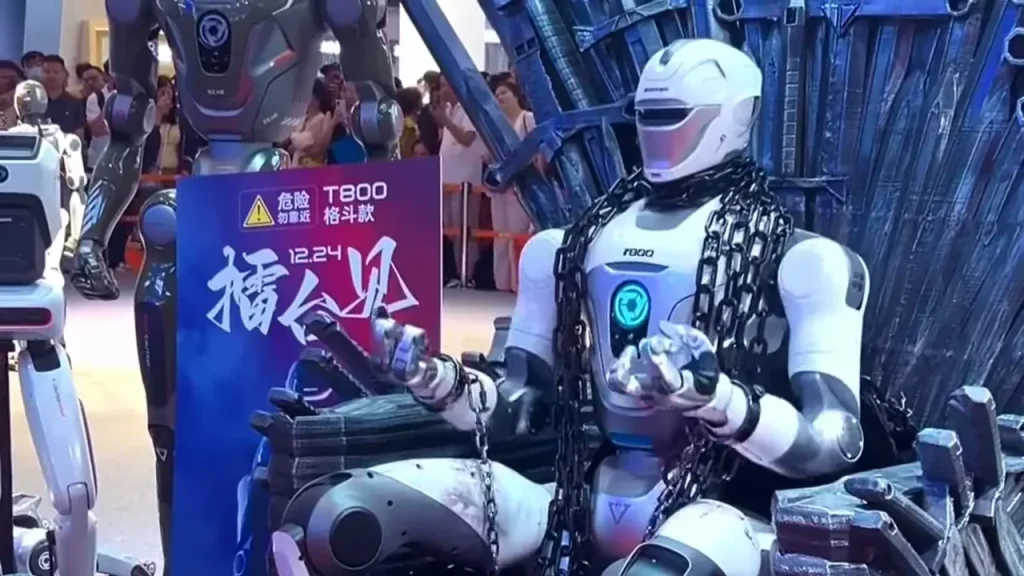
The company’s flagship combat robot, the T800 (named after the Terminator franchise), represents the next evolution in humanoid fighting machines. Unveiled at the 2025 World Robot Conference in August, the T800 stands 1.85 meters (6’1″) tall and weighs 85kg (187 lbs), placing it in the cruiserweight to heavyweight range by traditional boxing standards.
Technical specifications include 41 high degree of freedom joints, a solid state battery that provides enhanced safety and extended operation compared to conventional lithium ion packs, and aluminum alloy covers for structural resilience. The robot features a multi sensor fusion perception system integrating vision, tactile, and force sensors for real time environmental awareness, coupled with a high performance computing unit for rapid decision making.
Combat-Ready Humanoids
EngineAI’s marketing has embraced an aggressive, “combat ready” angle that distinguishes it from competitors focused on logistics and manufacturing applications. Promotional materials feature the T800 in fighting stances, and the company released CGI teaser videos showcasing dynamic poses and combat scenarios.
The T800 is scheduled to be the core competing model in EngineAI’s “Mecha King” free combat tournament, also called the “Robot Boxer” competition, scheduled for December 24, 2025 in Shenzhen. According to company announcements, this event will feature full scale humanoid robots and introduce pioneering rules demanding real time intelligent decision making, with plans to open source robot code for customization and training purposes.
Beyond combat applications, EngineAI has demonstrated a dual strategy of “spectacle and pragmatism.” In November 2025, the company deployed humanoids as “Cyber Staff” in a Shenzhen retail store operated in partnership with e-commerce giant JD.com, showing that combat capable robots can also function safely in human centric commercial environments.
Agibot: The Rising Contender
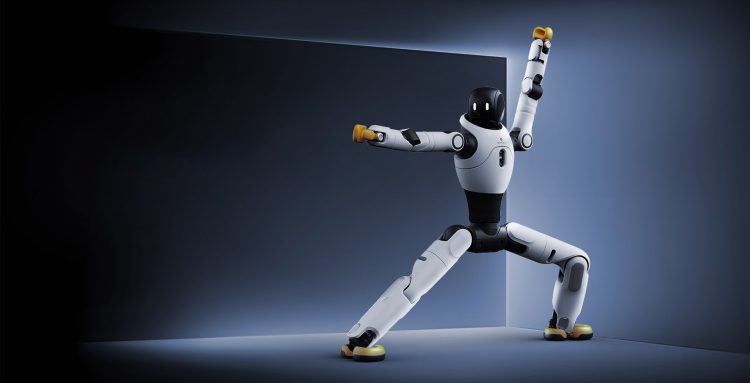
Shenzhen based Agibot, founded by Peng Zhihui (a former Huawei “Genius” recruit), has been developing next generation humanoid robots with improving mobility and combat capabilities. The company’s upgraded Lingxi X2 robot has been showcased at exhibitions and demonstrations throughout 2025.
Footage circulating on social media shows Agibot’s humanoid performing martial arts like moves and switching between bipedal and wheeled locomotion modes, demonstrating versatility for different operational scenarios. While Agibot has not yet announced dedicated combat events like Unitree or EngineAI, industry observers cite the company as one of China’s key players developing humanoids suitable for fighting applications.
Following President Xi Jinping’s visit to Shanghai’s AI innovation hub, Agibot reported significant progress in mobility and interactive capabilities. The company’s focus on full body coordination and dynamic movement positions it well for potential entry into combat sports markets.
In July 2025, Agibot and Damon Technology, a leading Chinese logistics automation firm, announced the industry’s first humanoid robot logistics training and data collection facility, aiming to advance robots from mechanical execution to autonomous decision making. This infrastructure development could provide valuable training data applicable to combat scenarios.
Booster Robotics: The Underground Fighter
Singapore based Booster Robotics has entered the humanoid combat space with its T1 model, which has appeared in Ultimate Fighting Bots competitions and underground fighting events in San Francisco. The T1 robot has been featured in remote controlled battles where operators use keyboards, controllers, or Joy-Cons to fight from anywhere with internet connectivity.
Booster’s approach emphasizes accessibility and remote participation, lowering barriers to entry for people interested in robot combat without requiring physical presence at events. Matches typically run for 10 minutes with the objective of knocking down opponents, creating fast paced entertainment suitable for online streaming.
Entertainment Companies: Organizing the Fights
REK (Robot Embodied Kombat): The VR Pioneers
Founded by Cix Liv, REK has established itself as the premier VR controlled humanoid robot fighting organization in the United States. Liv, who previously founded LIV in 2016 (a company that developed technology for live streaming VR sessions), brings extensive experience in immersive technology to robot combat.
REK’s distinguishing feature is its proprietary teleoperation system called REK TEK, which uses VR headsets to enable operators to “embody” robots in real time. Unlike competitors using traditional game controllers, REK pilots don VR headsets and use arm worn “combat controllers,” creating a one to one immersive experience where operators feel as though they’re inside the robot’s body.
The company burst onto the scene in September 2025 with what it billed as the world’s first VR controlled humanoid robot fight event at San Francisco’s Temple nightclub. The inaugural event significantly overbooked the 2,500 person venue capacity, selling nearly 3,400 tickets and becoming the largest draw in Temple’s 20-year history. Featured pilots included Twitch co founder Justin Kan and UFC veteran Hyder Amil controlling Unitree G1 robots.
Sold Out Tour
Building on this success, REK launched the REK America tour in November 2025, bringing humanoid robot fights to five major US cities:
- Los Angeles (November 11)
- Las Vegas (November 13)
- Austin (November 17)
- Miami (November 20)
- New York City (November 25)
Every venue sold out in advance, demonstrating sustained nationwide demand for robot combat entertainment. The tour’s 100% sell out rate across geographically and culturally distinct cities validated REK’s business model and confirmed that robot fighting appeals to mainstream American audiences, not just niche tech enthusiasts.
REK operates from a warehouse off Van Ness Avenue in San Francisco where humanoid robots hang from gantries, outfitted with boxing gloves, armor, and occasionally swords. The company’s approach blends sport with theatrical storytelling, developing backstories and personalities for robot fighters. One robot, DeREK, gained viral fame in July 2025 when a video showed it malfunctioning and thrashing violently while suspended from a gantry, eventually causing its head to partially detach. Rather than hiding the incident, founder Cix Liv posted it publicly with the caption “please make this go viral so I can pay for repairs,” demonstrating transparency that resonated with audiences.
Chief Technology Officer Amanda Watson, who has experience addressing latency problems in VR systems, has been crucial to making pilot movements feel natural and real time. In combat sports, milliseconds of lag can break immersion, so REK’s engineering team has prioritized minimizing latency to create fights resembling true athletic contests.
The Next Level: Power Upgrades
REK currently uses Unitree robots but plans to transition to larger humanoids matching adult male height and size. The company is also developing the Unitree H1_2 platform, which stands nearly 6 feet tall and weighs 154 pounds (70kg). Watson noted that “unlike the Unitree G1, the H1_2 COULD hurt you,” signaling REK’s evolution toward more powerful and potentially dangerous combat machines.
The company’s website (rek.com) and social media presence (@REKrobot on X) currently list open positions across robotics engineering, AI development, VR software, event production, content creation, and mechanical maintenance, indicating plans for significant expansion following the successful tour.

Ultimate Fighting Bots (UFB): Accessible Remote Combat
Ultimate Fighting Bots (UFB) emerged in 2025 as a competing humanoid fighting league with a different technical and business approach from REK. Founded by Michael Cho and married couple Xenia and Vitaly Bulatov, UFB describes itself as “the world’s first robot combat league” where humans pilot robots in real time battles from underground arenas or remotely from anywhere on the planet.
UFB’s key differentiation is accessibility through traditional control methods. While REK focuses on VR immersion, UFB targets a more game like experience using standard controllers, keyboards, or browser based remote piloting. This approach lowers technical barriers and enables broader participation from operators who may not have VR equipment or experience.
The organization held its first events at San Francisco’s Frontier Tower building (formerly housed in parking garage spaces) as invite only underground fights. The events created a cyberpunk aesthetic with neon lighting, drink dispensing machines, themed photo booths, and promotional materials advertising “bot brawling betting services” and other futuristic entertainments.
Another Unitree Partnership in Humanoid Combat Sports
In November 2025, Unitree Robotics announced a partnership with UFB, with the robotics manufacturer stating: “We are excited to be the robotics partner with @UFBots to bring the joy of the emerging sport of humanoid boxing to Los Angeles!” UFB announced plans to open an “LA House” in partnership with Unitree in November 2025.
An event scheduled for November 15, 2025 was promoted as “UFB 2” featuring new robots, new moves, and real stakes, with live streaming capabilities for remote viewers. The organization’s website (ufb.gg) offers various game modes including deathmatch free for alls, team battles, and other competitive formats.
UFB has developed character driven marketing with tongue in cheek robot fighter profiles. Examples include “the.DISRUPTOR,” described as “a hoodie wearing, hyperactive robot who dropped out of robot college after one semester,” and “Colonel Havoc,” “the serious, no nonsense D.E.R.P.A. military bot who commands the ring like a tactical operation.” This storytelling approach creates personality and narrative hooks that help audiences connect emotionally with mechanical combatants.
The organization streams fights on Twitch and maintains social media presence at @UFBots, which joined X (formerly Twitter) in March 2025 and has grown to over 100,000 followers. The rapid social media growth indicates strong public interest in accessible robot combat entertainment.

EngineAI’s Mecha King Tournament
Beyond its hardware manufacturing, EngineAI is also directly organizing combat events. The Mecha King tournament, scheduled for December 24, 2025 in Shenzhen, is described as the world’s first free fighting tournament featuring full sized humanoid robots.
The event aims to be “the ultimate test of the robot’s dynamic stability and AI capabilities,” according to promotional materials. By hosting its own competition, EngineAI can showcase its T800 platform while controlling the competitive environment and rule structures. The company has stated intentions to demand real time intelligent decision making and plans to open source robot code for customization.
This vertical integration strategy—manufacturing combat hardware and organizing premier competitions—positions EngineAI as both supplier and standard setter for the industry. The December event will be closely watched to see if full sized humanoids create a more compelling spectacle than the smaller G1 robots dominating current competitions.
Supporting Infrastructure: Betting and Ecosystem
Robo Rumble: Prediction Market for Robot Battles
Robo Rumble (roborumble.io) has positioned itself as “the world’s first prediction market for robot battles,” creating a betting and speculation platform specifically for humanoid combat sports. Built on Peaq blockchain infrastructure, Robo Rumble aims to make robot combat “fast, fun, and cryptonative.”
The company emerged from stealth mode by sponsoring REK’s first VR controlled robot fight (REK 0) in September 2025, featuring Twitch co-founder Justin Kan versus UFC veteran Hyder Amil. This strategic sponsorship aligned Robo Rumble with the highest profile robot fighting event to date.
According to information from Peaq, Robo Rumble will launch its prediction market on the Peaq blockchain, accessing cross chain flexibility and liquidity while leveraging network effects with other decentralized applications. The platform enables users to bet on robot fight outcomes, creating financial incentives for audience engagement beyond pure entertainment.
Co-founder Juan Ma stated: “Robots in the ring are a great reminder that we actually live in a sci-fi movie, we just haven’t realized it yet ourselves. Robo Rumble is the wake up call, bringing the thrill of robo fighting to everyone, and peaq, the home of robotics, is the place to be for us.”
The company’s website currently features a waitlist for beta access, indicating the platform is still in development stages. Robo Rumble’s social media presence (@roborumbleio on X) provides updates on upcoming supported fights and platform development.
The prediction market approach could significantly enhance the business model for robot fighting by creating new revenue streams beyond ticket sales and sponsorships. If successful, betting activity could drive viewership and create self sustaining financial ecosystems around robot combat events.

Other Ecosystem Players
The humanoid combat industry is attracting supporting businesses beyond direct competitors. Frontier Tower in San Francisco, which hosted UFB events, is transforming into a “self governed vertical village” described as a hub for frontier technologies including AI, robotics, neuroscience, and arts. The 16-floor building offers “Founding Citizenship” memberships that provide priority access to robot fighting events alongside coworking and community spaces.
Media companies are also entering the space. China Media Group partnered with Unitree for the Hangzhou boxing competition, providing broadcast production and distribution. As robot combat gains mainstream attention, traditional sports media companies may create dedicated coverage divisions similar to how esports has been integrated into sports broadcasting.
Technical Challenges Facing the Industry
Despite rapid progress, humanoid combat sports face significant technical limitations that companies must address:
Robot Durability: Current humanoids overheat when actuators fire rapidly during extended combat sequences. Companies are developing better cooling systems and more efficient actuators, but thermal management remains a constraint on fight duration and intensity.
Balance and Stability: Robots frequently fall when attacks miss or when they take unexpected impacts. While some robots can autonomously recover from falls, improving stability during co mbat remains a priority. Missed kicks in kickboxing and robot on robot collisions in soccer regularly result in falls that interrupt action.
Control Latency: For remote controlled fights, any lag between operator input and robot response degrades the experience. REK’s focus on minimizing latency through optimized VR systems and UFB’s use of simpler control schemes both attempt to address this challenge, but as fight complexity increases, latency management becomes more critical.
Battery Life: Combat is energy intensive. Current humanoids have limited operation times before requiring recharging. EngineAI’s use of solid state batteries in the T800 represents one approach to extending fight duration, but battery technology remains a limiting factor.
Safety: As robots grow larger and more powerful, safety concerns increase. The H1_2 robots REK plans to deploy could genuinely injure humans. Event organizers must develop comprehensive safety protocols for operators, spectators, and technical staff while maintaining the excitement that makes combat entertaining.
AI vs. Human Control: The industry hasn’t settled on optimal control paradigms. Fully autonomous robots would eliminate latency concerns but current AI can’t match human tactical decision making. Human control provides better fights but introduces technical complexity. Hybrid approaches with AI assisted movements may emerge as the solution.
Market Dynamics and Competition
The humanoid combat sports industry exhibits both competitive and collaborative dynamics. While REK and UFB compete for audience attention and venue bookings in the US market, both rely on Unitree hardware, creating interdependence between manufacturers and entertainment companies.
Chinese companies dominate hardware manufacturing due to government support, manufacturing infrastructure, and aggressive pricing. The Bank of China’s one trillion yuan ($140 billion) investment in domestic AI and robotics in January 2025 provided capital that US companies can’t match. This has resulted in Chinese humanoids costing $16,000-$90,000 compared to higher price points for Western platforms.
However, US companies lead in entertainment production and storytelling. REK’s VR immersion, UFB’s character development, and both companies’ event production capabilities demonstrate American strengths in creating compelling experiences. The ideal competitive position may involve Chinese hardware with US entertainment expertise—the model both REK and UFB currently employ.
Geographic expansion will be crucial. REK’s successful US tour proved American market viability. UFB’s remote control approach enables global participation. EngineAI’s Shenzhen event will test Chinese domestic appetite for robot combat entertainment. European, Japanese, and Middle Eastern markets remain largely untapped.
The entry of established sports organizations could reshape the industry. UFC CEO Ari Emanuel’s November 2025 statement expressing interest in hosting robot fights suggests traditional sports entities see opportunity in humanoid combat. If major leagues create robot fighting divisions, independent startups may become acquisition targets or equipment suppliers rather than primary promoters.
Business Models and Revenue Streams
Companies in the humanoid combat space are exploring multiple revenue models:
Ticket Sales: Physical event attendance has proven viable, with REK’s sold out tour demonstrating demand for live robot fighting. Premium seating, VIP experiences, and meet and greets with pilots and robots create tiered pricing opportunities.
Streaming and Media Rights: Online viewership enables global audiences. As viewership grows, media rights sales to broadcasters and streaming platforms could become significant revenue sources.
Hardware Sales: Manufacturers like Unitree and EngineAI sell robots to event organizers, independent teams, research institutions, and eventually consumers. As combat sports drive hardware improvements, consumer interest in owning personal fighting robots may develop.
Sponsorships: Brands seeking association with cutting edge technology and entertainment can sponsor events, teams, or individual robot fighters. As audiences grow and demographics become clearer, sponsorship values will increase.
Betting and Gaming: Robo Rumble’s prediction market model creates revenue from betting activity. Traditional sports betting companies may also enter the space as robot combat gains legitimacy.
Licensing and IP: Successful robot fighters could become intellectual property with value beyond combat. Merchandise, action figures, video games, and media appearances offer licensing opportunities.
Training and Certification: As the sport professionalizes, companies could offer pilot training programs, certification for operators, and development of coaching services.
Technology Licensing: Control systems like REK TEK have applications beyond entertainment in industrial robotics, military training, and other fields. Licensing proprietary technology could provide recurring revenue.
Regulatory and Ethical Considerations
As humanoid combat sports grow, companies will face regulatory scrutiny:
Safety Standards: Governments may establish requirements for robot combat events similar to regulations governing human combat sports. Certification processes for robots and operators, venue safety requirements, and insurance mandates could emerge.
Liability: When robots malfunction or cause injuries, liability questions arise. Clear legal frameworks determining responsibility—manufacturers, event organizers, or operators—will be necessary as the industry matures.
Content Restrictions: Different jurisdictions may impose restrictions on robot combat entertainment. Countries with strict regulations on violence in media might limit streaming or event promotion.
Labor and Employment: As robot combat becomes professionalized, questions about pilot employment status, contract terms, and labor protections will surface. Union organization among robot pilots could emerge.
Ethical Concerns: Some observers question whether conditioning audiences to enjoy robot violence could have social implications. While current robots lack sentience, future AI advances may complicate ethical considerations.
International Competition: Geopolitical tensions could impact the industry. US-China technology competition might affect hardware access, event collaboration, or participation restrictions.
Future Trajectories and Strategic Positioning
Companies are positioning for several potential industry evolutions:
Autonomous Combat: As AI improves, fully autonomous robot fighters could eliminate human pilots entirely. Companies investing in AI development position themselves for this transition, while those focused on human control may need to adapt.
Robot Personality and Character: Entertainment value increasingly depends on robot characters having personalities, backstories, and fan followings. Companies investing in storytelling and character development will differentiate from pure technical demonstrations.
Training Infrastructure: Just as human combat sports require gyms, coaching, and training facilities, robot combat will need similar infrastructure. Companies building training facilities and coaching services create recurring revenue while developing talent pipelines.
League Structures and Seasons: Moving from one off events to seasonal competitions with rankings, playoffs, and championships will professionalize the sport. Organizations establishing league structures early will have first mover advantages.
Integration with Traditional Sports: Partnerships with established sports organizations could accelerate mainstream adoption. Companies positioned as suppliers to UFC, WWE, or other traditional promoters may achieve scale more quickly than independent paths.
Consumer Products: Eventually, consumer grade fighting robots could enable neighborhood leagues and amateur competition, similar to how recreational sports thrive alongside professional leagues. Companies that can deliver safe, affordable consumer fighting robots will tap enormous markets.
Conclusion: An Industry at the Starting Line
The humanoid combat sports industry stands at a pivotal moment. The technology has advanced sufficiently to create genuine entertainment value. Public interest has been demonstrated through sold out events and viral online engagement. Investment capital is flowing into the sector. Pioneering companies have established initial positions in manufacturing, entertainment, and supporting infrastructure.
Yet the industry remains in its earliest stages. Technical limitations constrain what’s possible. Business models are unproven at scale. Regulatory frameworks are undeveloped. Market leaders today could be displaced by companies that haven’t yet launched or by unexpected technological breakthroughs.
Unitree’s dominance in hardware manufacturing, REK’s success in VR controlled combat entertainment, UFB’s accessible remote control platform, EngineAI’s purpose built combat robots, Agibot’s advancing capabilities, and Robo Rumble’s prediction market infrastructure each represent different strategic approaches to capturing value in this emerging industry.
The companies that will ultimately dominate humanoid combat sports may not yet exist. They might be traditional sports organizations leveraging existing brand power and distribution, technology giants with AI and robotics capabilities, or entirely new entrants with breakthrough innovations.
What’s clear is that 2025 has established humanoid robot combat as more than theoretical. It’s now a nascent industry with real events, paying customers, and companies racing to build sustainable businesses. The robots are in the ring. The fights are happening. The question is no longer whether humanoid combat sports will exist, but which companies will shape how this new form of entertainment evolves and who will capture the economic value it creates.
For those interested in participating—whether as engineers, operators, entrepreneurs, or investors, the time to engage is now, while the industry’s structure remains fluid and opportunities for impact are greatest.
Discover more about Humanoid Sports