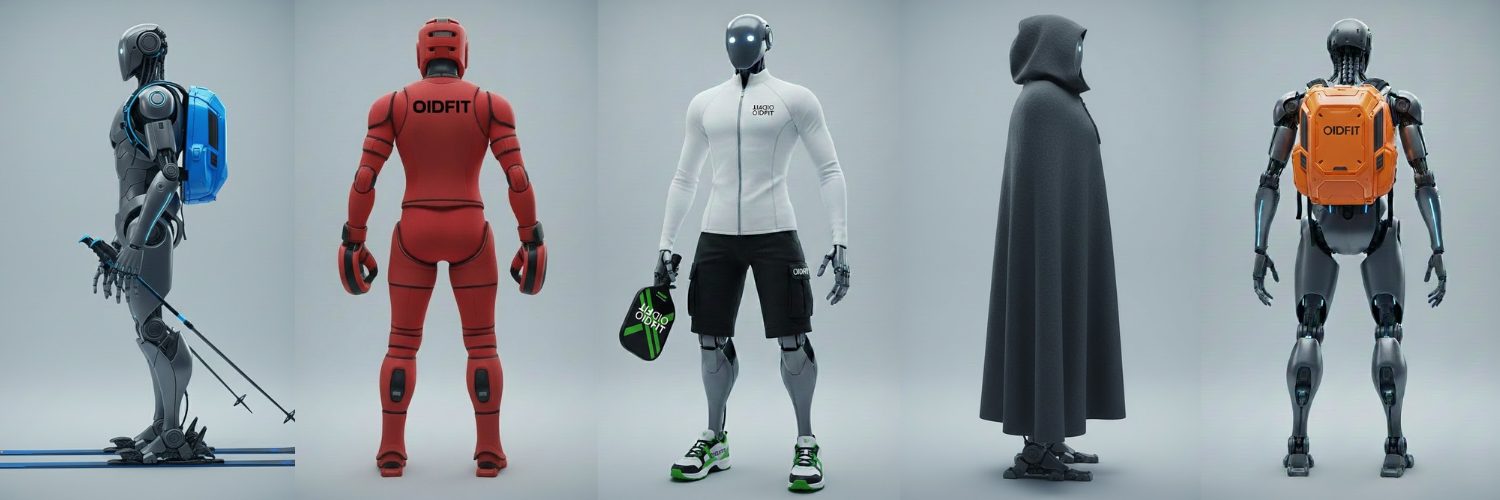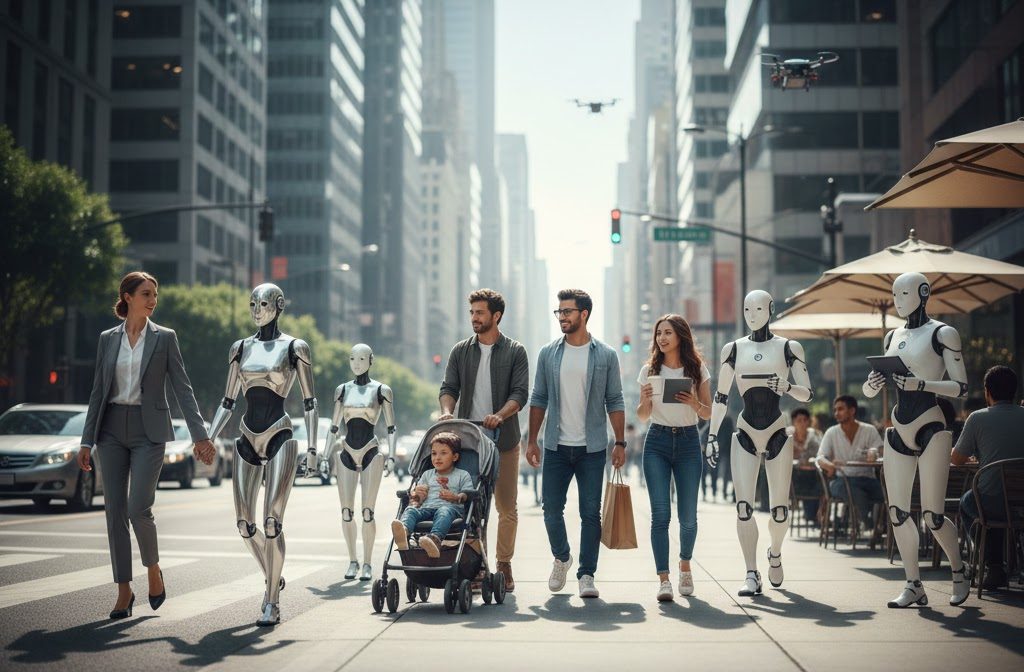





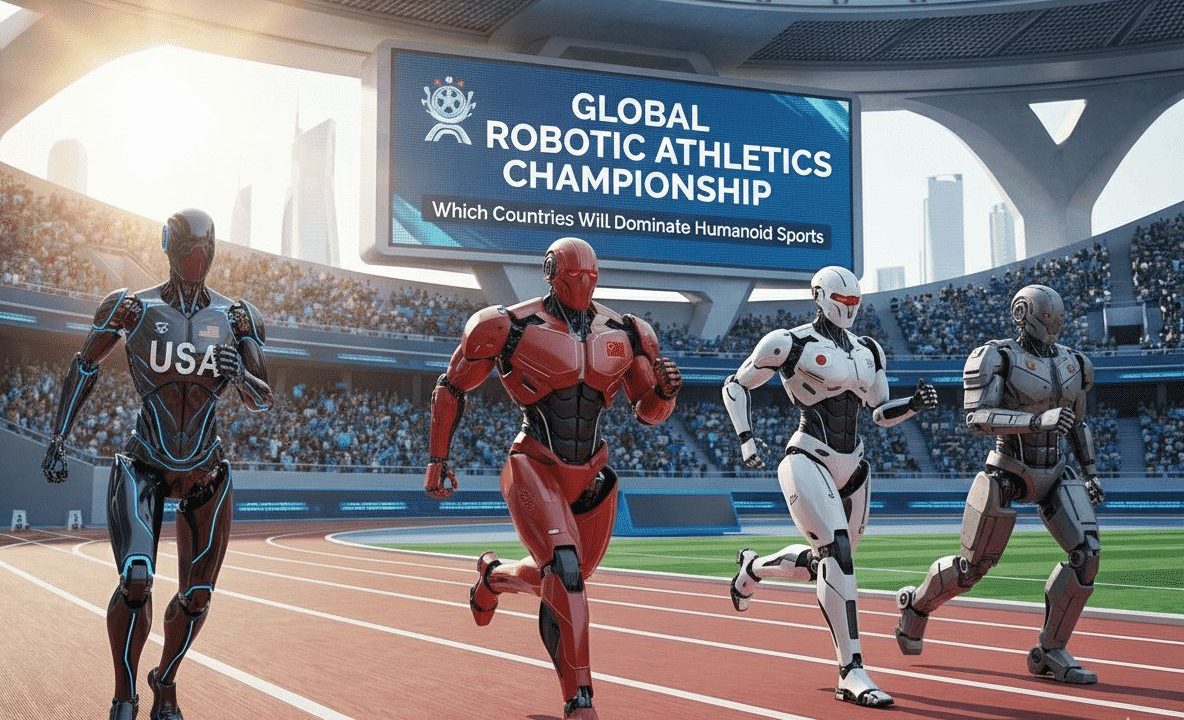
As humanoid robot sports emerges as a legitimate entertainment industry, the race is on between nations to establish dominance. Here’s who’s positioned to win and why it matters.
The future of sports isn’t entirely human. As 2025 established humanoid sports as reality rather than science fiction, a new question emerges: which countries will dominate this emerging multi billion dollar industry?
The answer isn’t obvious. Unlike traditional sports where athletic culture and population size matter most, or eSports where internet penetration and gaming culture dominate, humanoid sports requires a unique combination of technological capability, manufacturing prowess, AI development, regulatory environment, capital availability, and, eventually cultural embrace of robot athletics.
After analyzing investment flows, manufacturing capacity, technological development, government support, and early competition results, five nations emerge as frontrunners. The pecking order might surprise you.
China: The Overwhelming Favorite
If you’re placing bets on which country will dominate humanoid sports over the next decade, China is the smart money. The evidence is overwhelming.
The Manufacturing Superpower
China isn’t just participating in humanoid robotics, it’s attempting to monopolize it. According to Morgan Stanley research, by 2050, China will have 302.3 million humanoid robots in operation compared to just 77.7 million in the United States. That’s nearly 4:1 dominance.
The Chinese Institute of Electronics projects the country’s humanoid robot market will reach 870 billion yuan ($120 billion) by 2030, starting from just 2.76 billion yuan ($377.56 million) in 2024. That’s a 44-fold increase in six years.
The manufacturing advantage is already visible. In the first nine months of 2025 alone, China recorded over 610 robotics investment deals totaling 50 billion yuan ($7 billion), a 250% increase year over year. The third quarter saw 243 deals, up 102% from 2024.
The Robot Army
China isn’t just building robots, it’s building an ecosystem. Major players include:
Unitree Robotics: Shocked the industry by pricing its R1 humanoid at just $5,900 in July 2025, with the G1 at $16,000 and H1 at $90,000. Multiple price tiers enable market penetration at every level. Unitree’s H1 robot won gold medals in both 400m and 1,500m races at the 2025 World Humanoid Robot Games.
UBTech Robotics: China’s first publicly listed humanoid company secured $1 billion in strategic financing in September 2025. The Walker S and Walker S Lite are deployed in factories with partners including BYD, Dongfeng Motor, Geely, FAW-Volkswagen, Audi FAW, BAIC New Energy, Foxconn, and SF Express.
EngineAI: Developing the combat focused PM01 ($14,000) and SE01 robots, with the recently unveiled T-800 specifically designed for robot boxing priced from $25,000.
AgiBots: Produced 1,000 general purpose humanoid robots by early 2025. The A2 model set a world record walking 66 miles across China in three days.
Robotera: Secured $140 million Series A+ funding led by Geely Capital and BAIC Capital, claiming $70 million in commercial orders for 2025.
Leju Robotics: Raised $200 million ahead of planned IPO, partnering with Huawei, Alibaba, and Haier.
Galbot: Backed by Hong Kong Investment Corporation’s $8 billion fund, developing AGI powered humanoids.
X Square Robot: Completed eight funding rounds in less than two years, raising $280 million total.
Government Support Unlike Anywhere Else
China’s approach to humanoid robotics isn’t market driven, it’s strategic national priority. The Chinese Communist Party identified embodied AI as a core tool for economic transformation in the March 2025 Government Work Report, alongside biomanufacturing, quantum technologies, and 6G.
The Ministry of Industry and Information Technology issued “Guiding Opinions on the Innovative Development of Humanoid Robots” in November 2023, setting clear targets: establish a secure and reliable supply chain by 2025, and position China to lead global humanoid robotics by 2027.
Local governments are competing to become robotics hubs. Beijing prioritizes AI chip development for embodied AI. Shanghai focuses on sensor technologies. Guangdong and Zhejiang concentrate on complete humanoid platforms. Hubei targets smart vehicles with embodied AI.
This isn’t cheerleading, it’s coordinated industrial policy backed by billions in subsidies, tax breaks, infrastructure investment, and regulatory support.
Supply Chain Dominance
Perhaps China’s most insurmountable advantage: nearly every global humanoid robot manufacturer depends on Chinese supply chains for critical components, screws, reducers, motors, batteries, sensors, and actuators.
As Morgan Stanley notes, “there are few U.S. based alternatives for many humanoid components.” Even American companies like Tesla, Boston Dynamics, and Figure AI source critical parts from China and other parts of Asia.
This supply chain control creates leverage. As China’s domestic humanoid industry scales, component costs drop for Chinese manufacturers while potentially increasing for foreign competitors if geopolitical tensions restrict exports.
Why This Matters for Humanoid Sports
Manufacturing scale translates directly to sports dominance. More robots mean more competitors, more teams, more leagues, more innovation, and more capital flowing into the sector.
Chinese automakers are already investing billions in humanoid robotics, bringing mass production expertise that will drive costs down while ramping up volume. Companies like Xpeng, BYD, Changan, GAC, Xiaomi, NIO, and Geely aren’t hobbyists, they’re industrial giants applying automotive supply chain logic to robots.
When combat humanoids cost $5,900 instead of $50,000, universities, sports organizations, and individual enthusiasts can field competitors. That accessibility creates the broad base necessary for sustainable sports leagues, exactly how traditional sports scaled.
China already demonstrated this playbook with drones. DJI achieved global dominance not through superior technology alone, but by manufacturing at scale with aggressive pricing that eliminated competitors. The same strategy is unfolding with humanoid robots.
United States: The Innovation Powerhouse Struggling to Scale
The United States possesses world class robotics talent, cutting edge AI development, and pioneering companies. But can innovation alone overcome China’s manufacturing juggernaut?
The Tech Giants
Boston Dynamics: The gold standard for dynamic robotics. Atlas remains the benchmark for agility, demonstrating parkour, backflips, and complex navigation that no other bipedal robot matches. However, Boston Dynamics historically focused on research and military applications rather than mass production. The electric Atlas is now piloting commercial deployment with Hyundai in automotive manufacturing, with plans for 2026-2028 commercial launch at estimated $140,000-$150,000 price point.
Tesla: Optimus represents Tesla’s bet on humanoid robotics, leveraging the company’s automotive manufacturing scale and Full Self Driving AI expertise. Elon Musk announced plans for 5,000 Optimus units by end of 2025, scaling to 100,000 by 2026. Target pricing: $20,000-$30,000 for mass production. Musk boldly claims humanoid robotics could account for 80% of Tesla’s future value, measured in “tens of trillions of dollars.”
Figure AI: Raised $675 million in February 2024 from Jeff Bezos, Microsoft, OpenAI, NVIDIA, Intel, and Cathie Wood’s Ark Invest, followed by an additional $1 billion in 2025. Valued at $2.6 billion, Figure is developing the Figure 02 humanoid integrating large language models with motor control for natural language tasking. Currently piloting at BMW’s Spartanburg plant for automotive assembly.
Agility Robotics: Digit targets logistics and warehouse deployment, with paid pilots already generating revenue at Amazon and GXO facilities. Raised approximately $400 million in early 2025. Estimated pricing around $250,000, but positioned as “robots as a service” rather than outright sales.
Apptronik: Raised $403 million in 2025 to develop Apollo, targeting industrial and warehouse deployment. Emphasizes practical commercial applications over flashy demonstrations.
Innovation vs. Manufacturing
The U.S. robotics ecosystem excels at breakthrough research, novel algorithms, and pioneering applications. Boston Dynamics’ Atlas can perform acrobatics no Chinese robot currently matches. Tesla’s neural network approach to embodied AI is innovative. Figure’s integration of large language models is cutting edge.
But innovation doesn’t automatically translate to sports dominance. Consider the parallel with drones. American companies pioneered drone technology, yet China’s DJI dominates the global market with 70%+ market share through manufacturing scale and aggressive pricing.
The U.S. faces structural challenges:
Cost Disadvantages: American robots cost 2-10x more than Chinese equivalents. Boston Dynamics’ Atlas at $140,000+ versus Unitree’s H1 at $90,000 (and dropping). Figure 02 estimated over $100,000 versus EngineAI’s T-800 at $25,000.
Manufacturing Capacity: Tesla is the exception proving the rule, most U.S. robotics firms lack automotive scale production capability. Scaling from hundreds to millions of units requires manufacturing infrastructure America has largely offshored.
Supply Chain Dependencies: U.S. companies depend on Asian suppliers for critical components, creating cost disadvantages and potential geopolitical vulnerabilities.
Capital Efficiency: While U.S. firms raise large funding rounds, Chinese companies achieve similar or better results with less capital due to lower labor costs and established supply chains.
Regulatory Uncertainty
The U.S. lacks comprehensive federal regulation for personal humanoid robots, creating uncertainty for manufacturers and consumers. State by state variations complicate deployment strategies. This regulatory vacuum could benefit or hinder depending on how it resolves.
China’s more directive approach, establishing clear targets, subsidizing development, and coordinating supply chains, creates certainty that enables long term planning and investment.
The American Wildcard
The U.S. shouldn’t be counted out. American advantages include:
- AI Leadership: OpenAI, Anthropic, Google DeepMind, and others lead frontier AI research that powers embodied intelligence
- Capital Markets: Unmatched access to venture capital and public markets for fundraising
- Talent Pools: Top universities and research institutions producing world class robotics engineers
- Innovation Culture: Entrepreneurial ecosystem that rewards risk taking and rapid iteration
- Military Investment: DARPA and Department of Defense funding driving breakthrough research
High profile figures like UFC boss Ari Emanuel expressing interest in robot fights signal that American entertainment industry heavyweights see commercial potential. If major sports leagues, broadcasters, and entertainment conglomerates embrace humanoid sports, U.S. marketing and production expertise could offset manufacturing disadvantages.
South Korea: The Dark Horse Contender
South Korea punches above its weight in robotics, combining advanced technology with strategic government support and deep manufacturing expertise.
The Foundation
Robotics Heritage: South Korea has invested in robotics research for decades. Rainbow Robotics, founded by researchers from KAIST’s Humanoid Robot Research Center in 2011, developed Korea’s first two legged walking robot, “Hubo.”
Corporate Power: Hyundai Motor Group’s Boston Dynamics acquisition in 2021 for $1.1 billion signaled serious intent. Hyundai is now piloting Atlas robots in automotive manufacturing at its Georgia facility starting 2025.
Government Support: The South Korean government actively promotes robotics innovation through funding programs and research partnerships, recognizing demographic pressures from aging population.
Technology Leadership: Companies like Samsung, LG, and Hyundai possess advanced electronics, AI, and manufacturing capabilities transferable to humanoid robotics.
ROBOTIS and the Component Advantage
ROBOTIS, a South Korean firm, plays a crucial but underappreciated role in the global humanoid ecosystem. The company develops actuators, sensors, and control systems used by robotics firms worldwide.
In November 2024, ROBOTIS partnered with MIT to develop “Physical AI” focusing on human level physical intelligence. This collaboration aims to enhance precision robotics for industrial applications through reflexive AI and high level sensing systems.
ROBOTIS also supplies components to international robotics companies, creating revenue streams and technological influence beyond domestic manufacturing.
Why South Korea Could Surprise
Aging Demographics: South Korea faces one of the world’s fastest aging populations, creating urgent demand for care robots and automation. This demographic pressure drives both government support and market demand.
Electronics Expertise: Samsung, LG, and SK Hynix dominate global electronics manufacturing, producing sensors, chips, and displays essential for humanoid robots. This vertical integration creates advantages.
Quality Reputation: “Made in Korea” carries premium branding in electronics and automotive sectors, reputation advantages that could differentiate Korean humanoids as “high quality” options versus “cheap” Chinese alternatives.
Strategic Positioning: South Korea often succeeds as “fast follower,” observing U.S. innovation and Chinese manufacturing, then carving profitable niches combining both approaches.
For humanoid sports, South Korea could emerge as the “premium” option, robots that cost more than Chinese models but less than American ones, with reliability and quality positioning them for serious competition leagues.
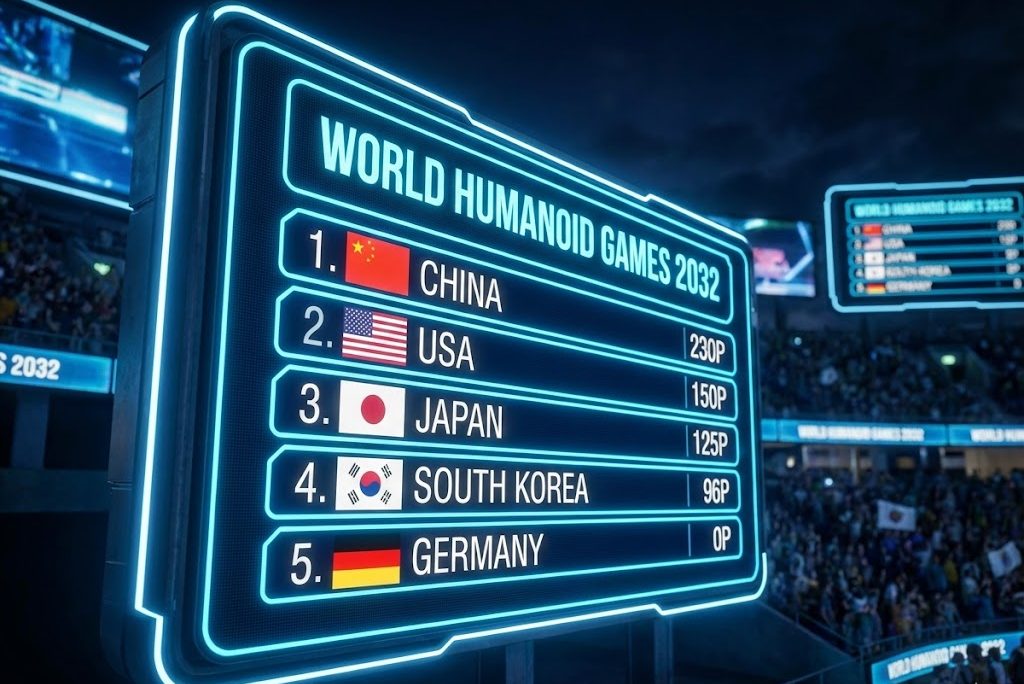
Japan: Legacy Robotics Power Facing Headwinds
Japan pioneered humanoid robotics decades before it became trendy. Honda’s ASIMO (1986-2018) was the world’s most famous humanoid for years. Yet Japan now risks being overshadowed.
The Legacy
SoftBank Robotics: Pepper robot, launched in 2014, became iconic for customer service applications. However, SoftBank has struggled to scale humanoid development and faced production challenges.
Honda: ASIMO represented cutting edge research but never commercialized. Honda retired the program in 2018, though recent reports suggest renewed interest in humanoid development.
Toyota: Maintains robotics research focused on assistance and mobility, but hasn’t launched consumer humanoids.
Kawasaki: Industrial robotics leader exploring humanoid applications, particularly in manufacturing.
The Challenge
Japan faces several disadvantages in the humanoid sports race:
Risk Averse Corporate Culture: Japanese companies prioritize perfection and long development cycles. This conflicts with the “move fast and iterate” approach of Chinese and American startups that’s proven effective in humanoid robotics.
Manufacturing Exodus: Much of Japan’s electronics manufacturing moved to China and Southeast Asia over past decades. Rebuilding domestic capacity is expensive and slow.
Demographic Crisis: Aging population creates demand for care robots, but shrinking working age population limits engineering talent pools.
Economic Stagnation: Decades of low growth constrain capital available for speculative investments like humanoid sports.
Risk Aversion: Japanese culture’s emphasis on safety and caution might limit appetite for combat sports where robots get destroyed, potentially the most commercially viable humanoid sports format early on.
Why Japan Still Matters
Technical Excellence: Japanese engineering expertise in precision manufacturing, quality control, and reliability remains world class.
Research Leadership: Universities like Tokyo Institute of Technology, Osaka University, and KAIST (Korea, but with Japanese collaboration) continue breakthrough research.
Component Suppliers: Japanese companies produce sensors, actuators, and specialized components used in humanoids globally.
Elderly Care Focus: Japan’s massive elderly care market could drive different humanoid applications that translate to sports capability, endurance, gentle interaction, navigation in complex environments.
For humanoid sports, Japan might excel in niche applications requiring extreme reliability or precision. Japanese robots could dominate certain sports categories even if China and the U.S. lead in combat and general athletics.
Europe: The Fragmented Union
Europe possesses robotics expertise but lacks the coordination, scale, and urgency to compete with Asia and the United States.
The Players
Germany: BMW, Mercedes-Benz, Volkswagen, and other automotive giants are deploying humanoid robots in manufacturing (BMW testing Figure 02 in Spartanburg plant). Germany emphasizes precision engineering and industrial applications.
United Kingdom: Engineered Arts created Ameca, one of the most expressive humanoid robots, focusing on entertainment and research. Limited commercial scaling.
Spain: PAL Robotics develops humanoids like REEM and Kangaroo for service and research applications. Strong in academic collaboration but small scale commercially.
Italy: Leonardo and other firms explore robotics but primarily focused on industrial automation rather than humanoids.
France: Some humanoid research but limited commercial development.
The European Disadvantage
Regulatory Burden: The EU AI Act classifies humanoids as “high risk AI systems,” requiring extensive conformity assessments, risk management, documentation, and penalties up to 6% of global revenue for non compliance. This cautious, bureaucratic approach favors safety over innovation.
Fragmentation: 27 EU member states with different languages, markets, and priorities create coordination challenges. No single market comparable to China or the U.S.
Manufacturing Decline: Europe has lost manufacturing competitiveness to Asia over decades. Rebuilding capacity is expensive.
Risk Aversion: European culture and regulation emphasize precaution and worker protection, potentially limiting combat sports applications where robots get damaged.
Capital Constraints: European venture capital ecosystem is smaller and more risk averse than U.S. counterparts, with less appetite for moonshot bets on speculative technologies.
Why Europe Won’t Lead Humanoid Sports
Humanoid sports will be driven by volume (China’s manufacturing), innovation (U.S. technology), or strategic niches (South Korea/Japan quality). Europe lacks advantages in any category.
European robots will likely compete in humanoid sports, but manufactured elsewhere and controlled by non European companies. Europe will be a market, not a leader.
The Wild Cards: Emerging Players and Surprises
Several nations could disrupt expectations:
Middle East
Saudi Arabia and UAE: Petrostates investing oil wealth in economic diversification see robotics as strategic. Developments like the UK’s Humanoid launching the Middle East’s first dedicated humanoid robotics showroom in Riyadh signal serious interest.
Both countries could fund development, host major competitions, and create regulatory frameworks favorable to robot sports. Saudi Arabia’s aggressive sports investments (LIV Golf, soccer, F1) show willingness to spend billions on sports legitimacy, humanoid sports could be next.
Singapore
Tech savvy city state with government support for robotics, strategic location, and business friendly environment. Could become testing ground for regulations and early competitions.
India
Massive engineering talent pool and growing tech sector, but currently lacks capital and infrastructure for humanoid manufacturing. Long term potential if investment flows increase.
What Determines Sports Dominance?
Humanoid sports success requires balancing multiple factors:
Manufacturing Volume: More robots equals more competitors, teams, leagues, and infrastructure
Cost Accessibility: Affordable robots enable grassroots participation and broad leagues
Technical Capability: Robots must actually perform athletically to create compelling competition
AI Development: Autonomous decision making crucial as leagues evolve beyond teleoperation
Capital Investment: Funding for development, competition organization, broadcasting, marketing
Cultural Acceptance: Audiences must embrace robot athletics as legitimate entertainment
Regulatory Environment: Enabling rather than restrictive rules for robot sports
Media/Entertainment Expertise: Production quality, storytelling, and marketing matter
China leads in manufacturing volume, cost accessibility, and capital investment. The U.S. leads in AI development and media/entertainment expertise. South Korea and Japan excel at technical capability. Middle East leads in willingness to invest in sports legitimacy.
The Competition Sports That Will Define Dominance
Different humanoid sports favor different national strengths:
Combat Sports: Volume and cost matter most. China’s manufacturing advantage positions it to dominate robot boxing, MMA, and fighting tournaments early on. Affordable combat robots enable more participants, creating better competition and more compelling entertainment.
Team Sports: AI development and coordination algorithms critical. U.S. advantage in software could shine in robot soccer, basketball, or team competitions requiring sophisticated multi agent coordination.
Precision Sports: Technical excellence matters. Japan and South Korea could excel in sports requiring extreme reliability, archery, shooting, gymnastics judged on execution.
Endurance Sports: Battery technology and mechanical reliability crucial. Chinese manufacturers optimizing for long operational duration have advantages in marathon running, distance cycling, or ultra endurance events.
Extreme Sports: Innovation and risk taking rewarded. U.S. companies might pioneer dangerous new formats, aerial robotics, extreme obstacle courses, or combat scenarios too risky for humans.
The $200 Billion Question
Humanoid sports industry projections range from $50-200 billion by 2040-2050, depending on adoption rates and mainstream acceptance. Which nation captures the majority of that value?
The answer will shape geopolitical dynamics, entertainment landscapes, and technological development for decades.
China’s manufacturing dominance positions it to flood the market with affordable competitors, capturing volume and establishing ecosystem standards, the Android strategy.
The U.S. could maintain premium positioning through superior AI, entertainment production, and brand value, the Apple strategy.
South Korea and Japan might carve profitable niches in quality and specialized applications, the Samsung/Sony strategy.
Europe risks being primarily a market rather than producer, the historical trajectory of consumer electronics.
Where the Smart Money Goes
For investors, entrepreneurs, and sports organizations deciding where to place bets:
Short Term (2025-2028): China dominates through manufacturing volume, cost accessibility, and aggressive government support. Early humanoid sports leagues will likely be Chinese organized or Chinese robot dominated.
Medium Term (2028-2035): U.S. innovation in AI and entertainment production could create premium leagues with superior viewer experiences, even if using Chinese manufactured robots initially. American sports marketing expertise shouldn’t be underestimated.
Long Term (2035+): Competition intensity increases as technology matures. South Korea and Japan could differentiate through quality and reliability. Middle East money could disrupt by funding world class leagues and infrastructure.
The most likely outcome: Chinese robots competing in American produced leagues with global audiences, similar to how Chinese manufactured smartphones run American software consumed worldwide.
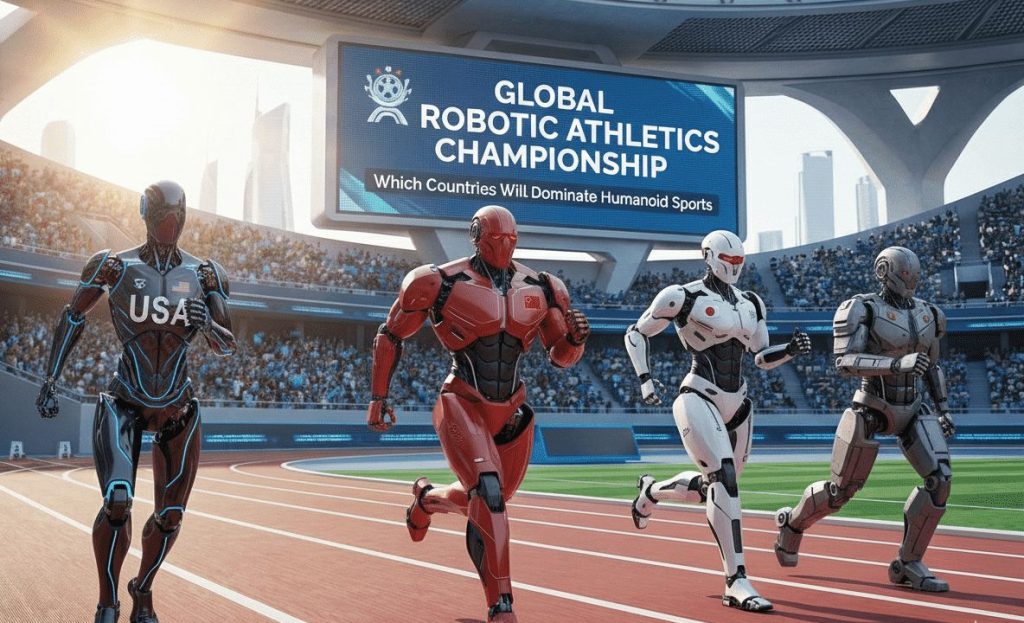
China Leads, But the Race Isn’t Over
China enters the humanoid sports era with overwhelming advantages. But sports history shows that manufacturing dominance doesn’t guarantee cultural dominance, Formula 1 cars are built in England and Italy, not Germany or Japan. The NBA thrives globally despite manufacturing most basketballs in Asia.
Tier 1: Clear Favorite
China: Manufacturing scale, cost advantages, government support, supply chain control, aggressive capital deployment
Tier 2: Strong Contenders
United States: AI leadership, innovation culture, entertainment expertise, capital markets, premium positioning potential
South Korea: Quality differentiation, strategic positioning, corporate backing, component expertise
Tier 3: Specialized Players
Japan: Technical excellence, precision applications, legacy expertise, but risk averse culture
Middle East: Capital abundance, strategic vision, regulatory flexibility, hosting capability
Tier 4: The Underdog
Europe: Fragmented markets, regulatory burden, declining manufacturing, but strong research base
Humanoid sports will likely feature Chinese manufactured robots competing in American organized leagues broadcast globally, with Middle Eastern funding and Asian technical components. No single nation will “own” humanoid sports entirely, but China’s foundation gives it the strongest starting position for the next decade.
The race to dominate humanoid sports is just beginning. Winning requires balancing technology, manufacturing, capital, culture, and entertainment in ways no nation has yet mastered completely. The country that figures it out first could define the future of sports for generations.
For comprehensive tracking of every major humanoid robot manufacturer and their capabilities, explore the Humanoid guide database tracking every commercial humanoid robot worldwide.
Want to follow which countries are winning the humanoid sports race? Subscribe to the Humanoid Sports Network newsletter for regular updates on international competitions, manufacturer developments, investment flows, and regulatory changes shaping the global humanoid sports industry.